 Back to webinar

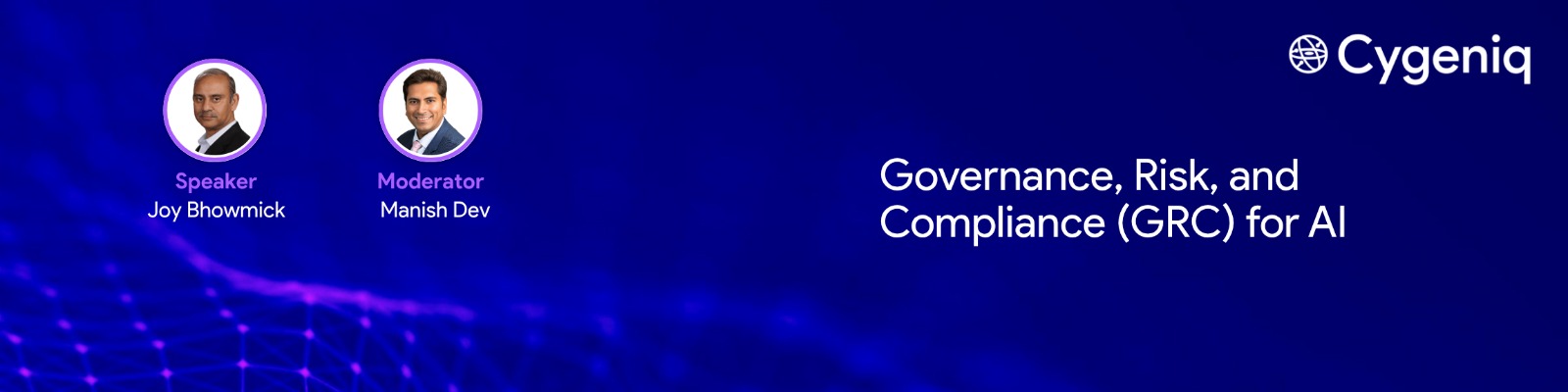
As Artificial Intelligence (AI) reshapes industries worldwide, the need for robust Governance, Risk, and Compliance (GRC) for AI has become critical. During a recent webinar hosted by Cygeniq, Joy Bhowmick, Co-founder and CTO, shared valuable insights on how enterprises in the USA, India, MENA, and beyond can establish AI systems that are secure, accountable, and aligned with global regulations. The session was moderated by Manish, who guided the discussion and summarized key takeaways.
This blog captures the highlights of that insightful session, focusing on the evolving regulatory landscape, the unique risks posed by AI, and actionable strategies for building effective GRC for AI frameworks.
The Rising Urgency of GRC for AI
The adoption of agentic AI—where AI systems make autonomous decisions with minimal human intervention—has increased the need for comprehensive governance and risk management. With AI becoming central to enterprise operations, organizations must ensure their systems comply with diverse and evolving regulations, including:
- USA: Executive orders and the NIST AI Framework
- India: Draft policies and national AI strategies
- MENA (UAE): Appointment of an AI Minister and proactive national AI regulations
- EU and UK: EU AI Act and expansion of DORA into AI governance
Joy Bhowmick emphasized that GRC for AI is not just about policies on paper. It requires embedding governance and compliance into the very design, development, and deployment of AI systems.
The Unique Risk Landscape of AI
Unlike traditional machine learning models, modern Large Language Models (LLMs) produce outputs that are probabilistic and sometimes unpredictable. This creates challenges in:
- Ensuring fairness and eliminating bias
- Maintaining transparency and auditability
- Managing model drift over time
- Detecting and addressing toxicity in outputs
Without proper GRC for AI, these risks can lead to regulatory penalties, operational failures, and reputational damage.
Building a Strong GRC for an AI Framework
During the discussion, the following strategies were highlighted:
1. Define a Clear AI Risk Taxonomy
Organizations should identify and categorize AI risks based on severity, business impact, and regulatory requirements before AI systems are deployed.
2. Integrate AI Governance from Day One
Governance should start during AI development. This includes maintaining model inventories, assigning ownership, and embedding guardrails throughout the AI lifecycle.
3. Monitor Continuously
Real-time monitoring is essential. AI systems must be checked constantly for compliance breaches, bias, and performance drift—not just at deployment.
4. Manage Third-Party AI Risk
Enterprises must extend their GRC for AI to include third parties and supply chain partners, ensuring vendor models and AI services also meet compliance standards.
Cygeniq’s Solutions for GRC for AI
Cygeniq offers advanced platforms to help organizations operationalize GRC for AI:
- Hexashield AI: A red teaming platform that continuously tests AI models against adversarial scenarios, providing risk scores and actionable insights.
- GRCortex AI: A comprehensive platform that helps define policies, control objectives, and risk registers while supporting automated compliance testing and continuous monitoring.
These solutions integrate with existing enterprise systems and are designed to scale with evolving AI regulations across the USA, India, the MENA region, and other global regions.
Conclusion
Governance, Risk, and Compliance for AI is no longer optional. As AI becomes central to enterprise decision-making, organizations must take proactive steps to build secure, transparent, and compliant AI systems. From defining risk taxonomies to embedding guardrails in the AI lifecycle and continuously monitoring for bias, toxicity, and drift, the time to operationalize AI GRC is now.
Cygeniq is committed to helping enterprises stay ahead of evolving AI risks and regulations with advanced platforms like Hexashield AI and GRCortex AI.
Discover more: Recorded YouTube Webinar
What does responsible AI security look like in your organization? Let’s continue the conversation at info@cygeniq.com


